At a Glance:
- Mild tooth sensitivity after a filling can occur, especially with cold, sweets, or pressure, and often becomes less noticeable as the tooth settles.
- Brief, improving sensitivity is generally less concerning than lingering, spontaneous, worsening, or throbbing pain.
- Pain when biting down after a filling may be related to excessive bite contact, but cracks, pulpal inflammation, and other causes should also be considered.
- Deep cavities and restorative factors can temporarily irritate the pulp. Persistent symptoms may require testing to distinguish reversible from irreversible pulpitis.
- Desensitizing toothpaste, gentle brushing, moderate food temperatures, and limiting frequent acidic exposures may help manage mild sensitivity.
- Increasing pain, persistent biting discomfort, swelling, fever, drainage, or other concerning symptoms warrant a dental assessment.
Having a cavity filled is supposed to solve a problem, so feeling new pain or sensitivity afterward can be unsettling. A quick jolt from cold water, discomfort when chewing, or an ache that was not there before treatment can naturally raise the question: Is tooth sensitivity after a filling normal, or is something wrong?
In many cases, short-term sensitivity reflects the tooth’s response to restorative treatment rather than a new problem. A tooth contains living tissues, including the pulp, which contains nerves and blood vessels. Preparing a tooth for a filling can temporarily affect the dentin and pulp. The depth of the cavity, the condition of the pulp before treatment, the bite after the filling, and the restorative material can all influence what you feel afterward.
The pattern of the pain matters. A brief cold “zing” may reflect temporary nerve irritation, while lingering throbbing, worsening heat sensitivity, or pain when biting can point to a different underlying cause that deserves closer evaluation.
The Biology of a Treated Tooth: Why Discomfort Happens
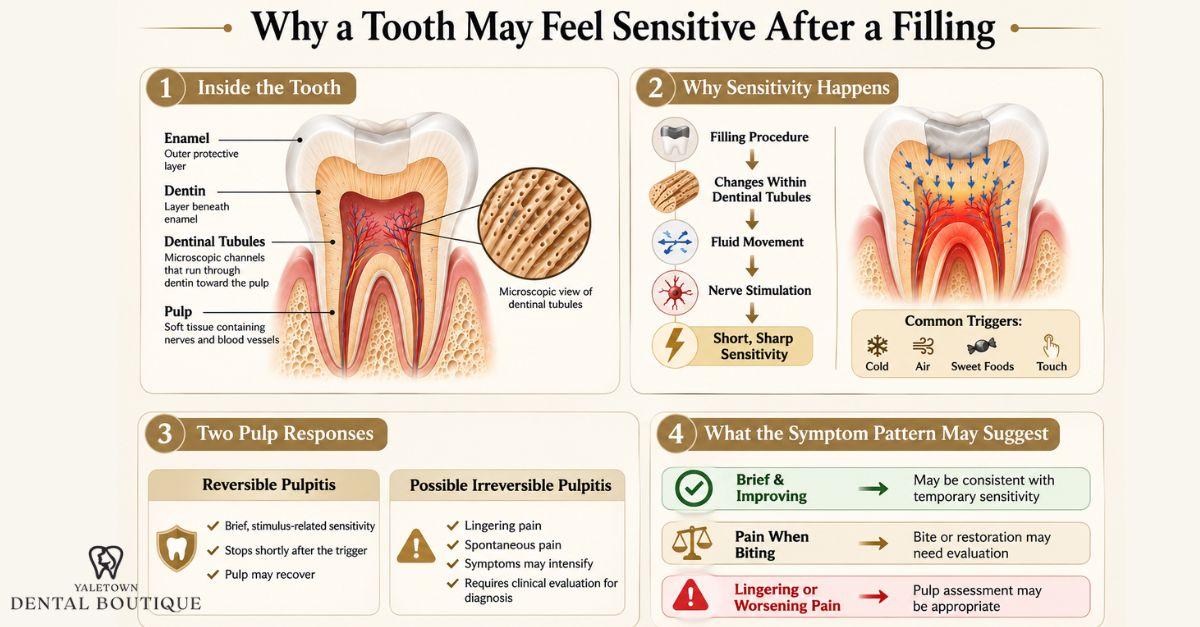
A tooth may look solid from the outside, but beneath the enamel is dentin, a mineralized tissue containing thousands of microscopic channels called dentinal tubules.
These tubules communicate with the pulp-dentin complex, where sensory nerve fibres contribute to the tooth’s response to external stimuli.
When decay is removed and a filling is placed, the preparation can temporarily change conditions within the dentin. Cutting dentin, drying the tooth, temperature changes during preparation, and restorative procedures can influence fluid movement within the dentinal tubules. According to the hydrodynamic theory of dentin sensitivity, rapid fluid movement within the dentinal tubules is thought to activate mechanosensitive nerve endings within the pulp-dentin complex, producing the familiar short, sharp “zing” triggered by cold, air, touch, or certain foods.
With composite fillings, additional steps such as acid etching and adhesive bonding prepare the tooth surface before the restorative material is placed. Composite resin also contracts slightly as it polymerizes, or hardens. The bonding technique, cavity depth, remaining dentin, and stresses created during polymerization can therefore influence postoperative sensitivity.
Reversible vs. Irreversible Pulpitis
Reversible pulpitis is a clinical diagnosis based on subjective and objective findings indicating that the inflamed pulp has the potential to recover when the underlying irritant is addressed. Symptoms may include a brief response to cold or sweet stimuli that resolves soon after the trigger is removed.
Irreversible pulpitis is a clinical diagnosis based on subjective and objective findings indicating that the inflamed pulp is unlikely to recover; the diagnosis should be made in conjunction with the patient’s history, clinical examination, pulp sensibility testing, and appropriate imaging. Lingering thermal pain, spontaneous pain, or persistent symptoms may raise concern, but no single symptom establishes the diagnosis.
Common Causes of Tooth Sensitivity After a Filling
| Common Sensitivity Triggers After a Filling and What They May Mean | |||
|---|---|---|---|
| Symptom Trigger | Possible Biological Process | Expected Course | Clinical Intervention |
| Cold, Air, or Sweet Foods | Fluid Movement Within Dentinal Tubules May Stimulate Pulpal Nerve Fibres | Often Decreases as the Tooth Settles | Monitor Symptoms; Desensitizing Measures May Help |
| Deep Filling | Reduced Remaining Dentin Thickness May Increase the Potential for Pulpal Irritation | Depends on Pulp Health and Cavity Depth | Pulp Testing May Be Needed if Symptoms Persist or Worsen |
| Composite Restoration | Polymerization Shrinkage and Stresses at the Bonded Tooth-Restoration Interface May Contribute to Postoperative Sensitivity | Often Temporary When the Pulp Remains Healthy | Assess Restoration, Margins, Bite, and Pulp if Symptoms Continue |
| Biting or Chewing | Excessive Occlusal Contact Can Place Additional Force on the Tooth and Periodontal Ligament | May Persist While the Bite Interference Remains | Dentist Can Evaluate the Bite and Adjust the Restoration When Indicated |
| Lingering or Spontaneous Pain | May Indicate More Significant Pulpal Inflammation | Less Consistent With Routine Short-Term Sensitivity | Clinical Examination and Pulp Testing Are Appropriate |
Tooth sensitivity after a filling can come from several different mechanisms, and the type of trigger often provides useful clues about what may be happening inside or around the treated tooth. Here are the common symptom patterns, their possible biological causes, typical course, and when clinical assessment may be appropriate:The pattern and progression of symptoms are often more useful than sensitivity alone. Brief discomfort that steadily decreases is different from pain that lingers after a trigger, occurs spontaneously, becomes progressively stronger, or interferes with sleep. These patterns can help guide further assessment but cannot establish a pulpal diagnosis on their own.
Evaluating Symptoms: Sharp Zings vs. Lingering Throbs
Not all tooth sensitivity after a filling means the same thing. Dentists consider what triggers the pain, how long it lasts after the trigger is removed, whether it occurs spontaneously, and whether symptoms are improving or worsening.
Brief, Sharp Pain With Cold or Sweets
A quick “zing” from cold water, cool air, or sweet foods can occur after a filling. Recent dental treatment can temporarily irritate the pulp, particularly when the original cavity was deep or the tooth has undergone significant preparation.
When discomfort is brief, occurs only in response to a trigger, and becomes less noticeable over time, the pattern may be more consistent with temporary dentin or pulpal sensitivity.
Lingering Pain After Hot or Cold
Temperature sensitivity deserves closer attention when pain continues after the hot or cold stimulus has been removed. A lingering response to thermal stimulation is one of the findings dentists consider when evaluating a tooth for more significant pulpal inflammation.
Lingering sensitivity does not establish a diagnosis by itself. The duration, intensity, progression, clinical examination, and results of pulp testing all need to be considered.
Spontaneous or Throbbing Pain
Pain that begins without an obvious temperature, food, or biting trigger differs from brief post-treatment sensitivity. Spontaneous pain can also be difficult to localize, and discomfort may sometimes seem to come from nearby teeth or another area of the jaw. Our guide to lower teeth pain explains several reasons dental pain can feel referred or difficult to pinpoint.
Persistent, worsening, or spontaneous pain after a filling should therefore be assessed rather than assumed to be part of routine recovery.
The Crucial Threshold: Reversible vs. Irreversible Pulpitis
The distinction between reversible pulpitis vs. irreversible pulpitis is based on the overall clinical picture rather than any single symptom:
| Reversible vs. Irreversible Pulpitis: Key Symptom Patterns | ||
|---|---|---|
| Pattern | More Consistent With Reversible Pulpal Irritation | May Raise Concern for Irreversible Pulpitis |
| Thermal Response | Brief Response That Resolves After the Stimulus Is Removed | Exaggerated or Lingering Response After the Stimulus Is Removed |
| Pain Pattern | Primarily Associated With an Identifiable Trigger | May Include Spontaneous or Persistent Pain |
| Progression | Symptoms Decrease as the Tooth Settles | Symptoms Persist or Become More Pronounced |
| Between Triggers | Tooth Is Generally Comfortable | Pain May Occur Without an Obvious Stimulus |
Clinical symptoms provide important diagnostic clues, but pulpal diagnosis should be based on the patient’s history together with clinical examination and appropriate diagnostic testing. Dentists combine the patient’s history with clinical examination, pulp sensibility testing, percussion or bite testing, and appropriate imaging before making a diagnosis.
Why does it hurt when I chew? The “high spot” problem
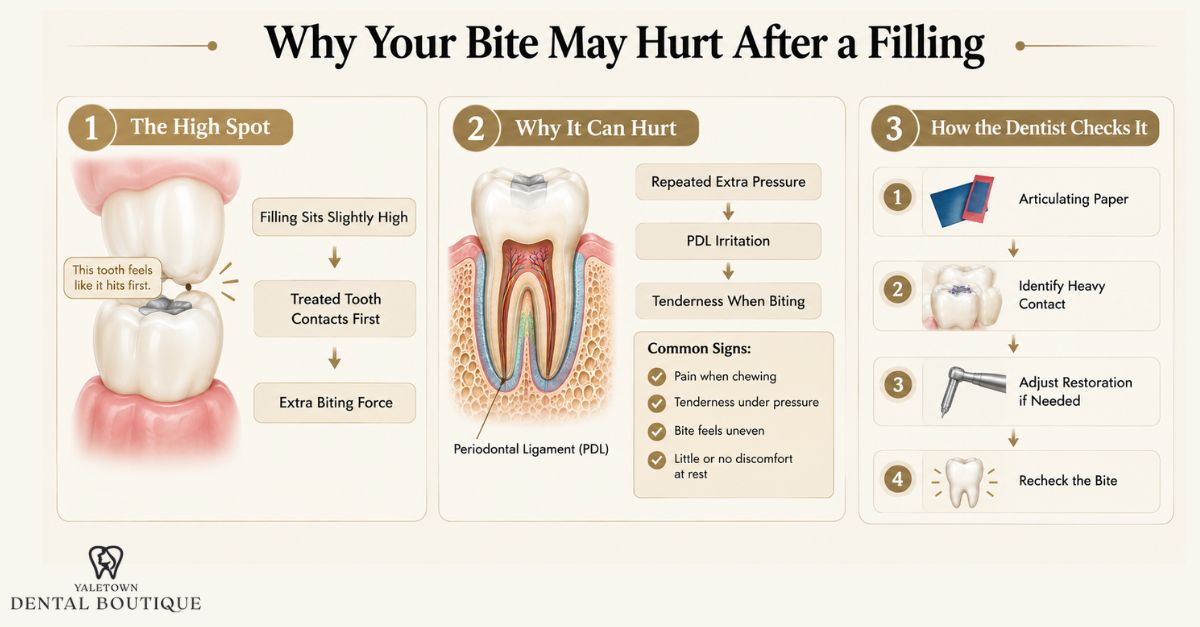
Pain when biting down after a filling can sometimes occur when the new restoration contacts the opposing tooth more heavily or earlier than intended. Even a small change in the way the teeth meet can concentrate additional force on the treated tooth during chewing.
How a High Filling Can Cause Biting Pain
Each tooth is connected to the surrounding bone by the periodontal ligament (PDL), a thin layer of connective tissue that helps support the tooth and respond to biting forces. When a restored tooth receives excessive or premature contact, the tissues supporting it may become irritated and tender under pressure.
You may notice:
- Pain or tenderness when chewing
- Discomfort when the teeth come together
- A sensation that the treated tooth “hits first”
- Little discomfort at rest but pain under biting pressure
This pattern differs from sensitivity triggered primarily by temperature because the discomfort is associated more closely with mechanical loading of the tooth.
Why You May Notice it After the Appointment
A subtle bite discrepancy may not always be apparent immediately after the filling is placed. Once local anesthesia wears off and you return to normal chewing, you may become more aware that the treated tooth contacts differently from the surrounding teeth.
Persistent biting pain should be evaluated rather than assumed to be part of normal adjustment.
How does a dentist check a high filling?
A dentist can evaluate the bite using articulating paper, which leaves coloured marks on areas where the teeth make contact. The markings help identify areas of occlusal contact and are interpreted together with the patient’s bite pattern and symptoms to determine whether an adjustment may be indicated.
If excessive contact is identified, a small amount of restorative material may be adjusted before the bite is checked again. This is sometimes referred to as a high filling adjustment.
A high filling is not the only possible cause of pain when chewing. Cracks, pulpal inflammation, problems with the restoration, or inflammation around the tooth can produce similar symptoms. Persistent or worsening pain therefore requires an assessment to identify the underlying cause.
The Post-Restorative Timeline: What Is Normal?
How long does tooth sensitivity last after a filling? When postoperative sensitivity occurs, it is often most noticeable during the first few days and tends to decrease over time. Some teeth settle relatively quickly, while others may remain sensitive for several weeks.
Rather than relying on an exact deadline, pay attention to the direction of your symptoms. Sensitivity that becomes milder and less frequent is different from pain that remains unchanged, becomes stronger, or begins occurring without a trigger.
Tooth Sensitivity After a Filling: General Timeline
Post-filling sensitivity can change as the tooth settles after treatment. Here’s a general timeline of what you may notice and which symptoms may warrant a closer assessment:
Tooth Sensitivity After a Filling: Recovery Timeline | ||
|---|---|---|
| Timeframe | What You May Notice | What to Watch For |
| Days 1–3 | Brief sensitivity to cold, air, sweets, or chewing may occur after treatment. | Severe or rapidly increasing pain or significant swelling requires assessment. |
| Days 4–7 | When sensitivity is present, it may begin becoming less frequent or intense. | Increasing pain, spontaneous throbbing, or persistent biting pain deserves evaluation. |
| Weeks 1–2 | Many teeth continue to settle, with less sensitivity to everyday triggers. | Lingering thermal pain or symptoms that show no improvement should be discussed with your dentist. |
| Weeks 3–4 | Some teeth, particularly those with deeper or more extensive restorations, may still have residual sensitivity. | Persistent, worsening, or newly developing pain should be evaluated rather than assumed to be routine healing. |
There is no single number of days that reliably separates expected post-restorative sensitivity from a condition requiring further evaluation. Clinical studies show that sensitivity generally decreases with time, but individual experiences vary.
The character of the pain also matters. Brief cold sensitivity that steadily improves is different from pain that lingers after the stimulus is removed, occurs spontaneously, becomes increasingly intense, or is consistently triggered by biting.
Red-Flag Symptoms
A dental assessment is appropriate if you experience:
- Pain that becomes stronger rather than improving
- Persistent or spontaneous throbbing
- Lingering temperature sensitivity
- Persistent or increasing pain when biting
- New or increasing swelling around the tooth or gums
- Fever or other signs of systemic illness
- Drainage or a pimple-like swelling near the affected tooth
Significant swelling, severe escalating pain, fever, or other signs of a potentially spreading dental infection may require prompt assessment. Yaletown Dental Boutique’s emergency dental care information provides additional guidance on urgent dental concerns.
At-Home Protocols to Calm Irritated Nerves
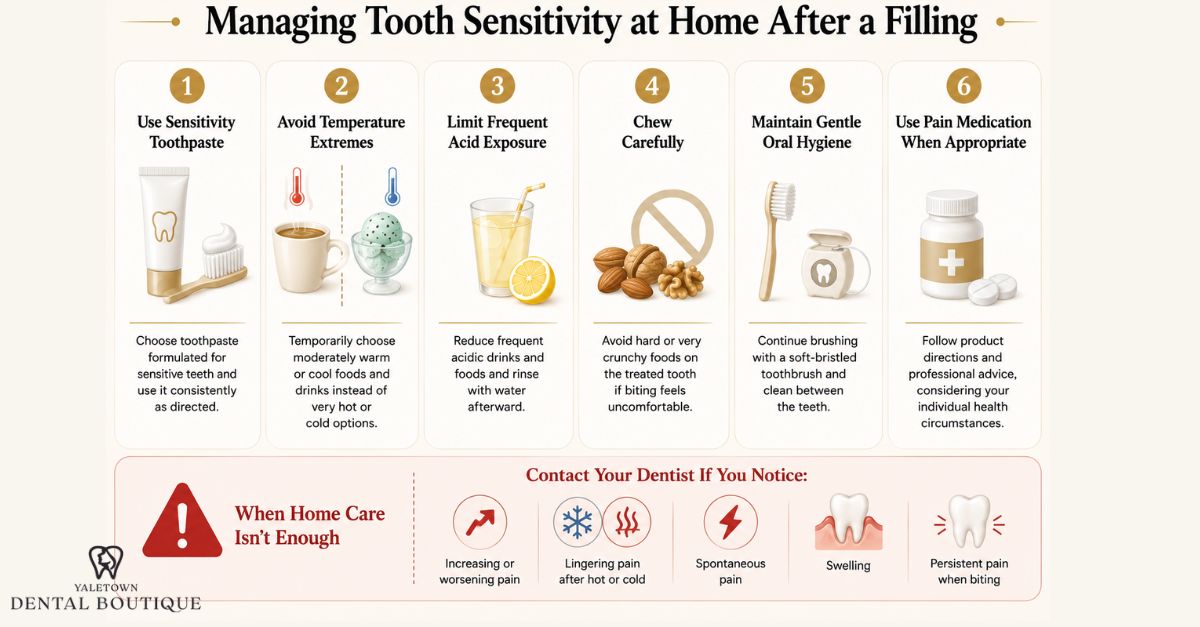
Mild tooth sensitivity after a filling may gradually settle as the tooth recovers. Home care can reduce common sensitivity triggers, but it cannot correct problems such as an uneven bite, a damaged restoration, or significant pulpal inflammation.
Use a Desensitizing Toothpaste
Toothpastes formulated for sensitive teeth may help reduce dentin sensitivity with regular use. Several active ingredients are used for this purpose, including potassium compounds and stannous fluoride.
Potassium-based desensitizing agents are proposed to reduce the excitability of pulpal nerves, although the precise mechanism of their clinical effect is not fully established, while some other desensitizing ingredients work primarily by reducing fluid movement through exposed dentinal tubules. Their effectiveness varies between formulations, so follow the product directions and give the toothpaste time to work rather than expecting immediate relief after one use.
Reduce Temperature Triggers Temporarily
Very cold or hot foods and drinks can trigger sensitivity in a recently restored tooth. If temperature changes cause discomfort, choosing foods and beverages at more moderate temperatures for a short period may make eating and drinking more comfortable.
As the sensitivity improves, you can gradually return to your usual diet based on comfort.
Limit Frequent Acidic Foods and Drinks
Frequent exposure to acidic foods and beverages can contribute to erosive tooth wear, which may expose or affect dentin and contribute to sensitivity. While the tooth is sensitive, reducing frequent exposure to soft drinks, citrus juices, sports or energy drinks, and other acidic products may help limit additional irritation.
After acidic foods or drinks, rinsing with water can help clear acids from the mouth. Avoid aggressive brushing, particularly when tooth surfaces are already sensitive.
Chew Carefully on the Treated Tooth
If biting pressure causes discomfort, temporarily avoiding hard or very crunchy foods on the affected tooth may help while symptoms are monitored.
Persistent pain when biting down after a filling should not simply be managed by avoiding the tooth. An uneven bite, crack, pulpal inflammation, or another problem may need to be ruled out.
Keep Brushing and Flossing
Continue brushing and cleaning between your teeth unless your dentist has provided different instructions. Use a soft-bristled toothbrush and gentle pressure around sensitive areas.
Consistent oral hygiene remains important after restorative treatment, while overly aggressive brushing can contribute to tooth-surface wear and gum recession over time.
Use Pain Medication only When Appropriate
Over-the-counter pain medication may be appropriate for some people with temporary discomfort, but suitability depends on health conditions, other medications, allergies, pregnancy, and other individual factors. Follow the product directions and advice from your dentist, physician, or pharmacist.
Home care is most appropriate when symptoms are mild and gradually improving. Increasing pain, spontaneous or lingering pain, swelling, or persistent biting discomfort should be assessed to determine the cause.
The Clinical Assessment: What Happens at a Comfort Check
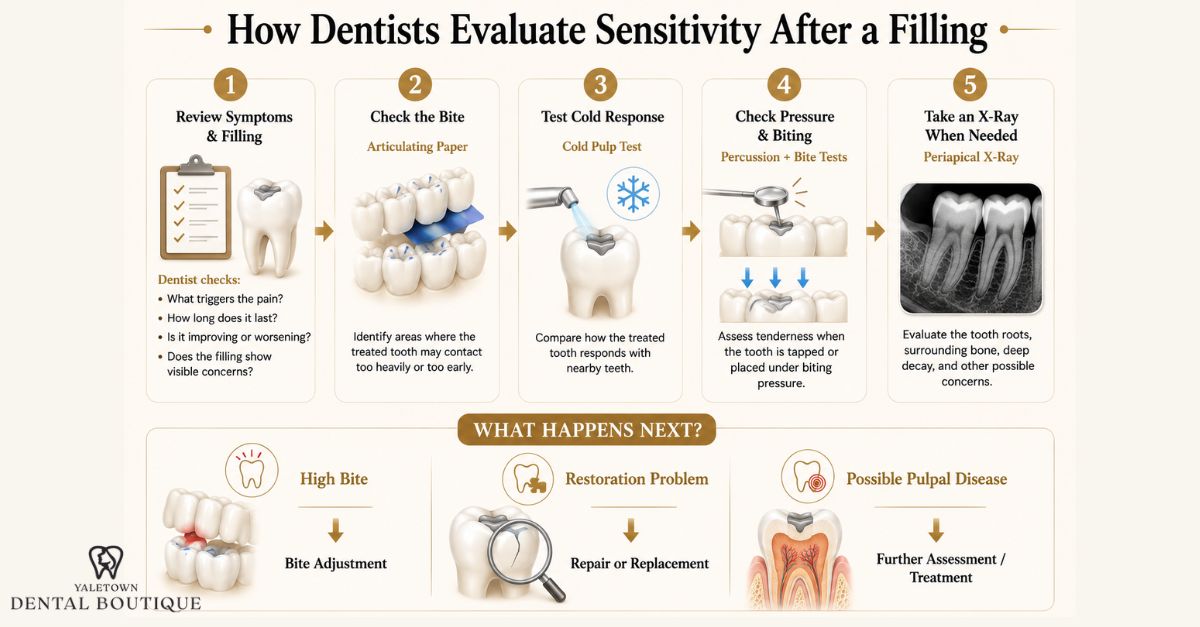
When sensitivity persists after a filling, the goal of a follow-up assessment is to determine where the pain is coming from and what may be contributing to it. Similar symptoms can result from an uneven bite, pulpal inflammation, a crack, problems with the restoration, or irritation of the tissues surrounding the tooth.
Dentists typically combine your symptom history with several clinical tests rather than relying on any single finding.
1. Symptom and Restoration Review
The assessment usually begins with questions about the pain: what triggers it, how long it lasts, whether it occurs spontaneously, and whether it is improving or worsening.
The dentist may also examine the filling and surrounding tooth for visible concerns, including damaged restorative material, marginal defects, cracks, decay, or changes in the nearby gum tissue.
2. Bite Assessment with Articulating Paper
If the tooth hurts when chewing or feels as though it “hits first,” the dentist may check your bite using articulating paper. The paper leaves coloured markings where the upper and lower teeth make contact, helping identify the location and pattern of occlusal contacts.
These markings are interpreted together with your symptoms and clinical examination. If excessive or premature contact is identified, the restoration may be adjusted and the bite checked again.
3. Cold Pulp Testing
A cold pulp test assesses how the tooth responds to a temperature stimulus, usually in comparison with nearby or control teeth. The dentist considers whether the tooth responds, the character of that response, and whether the sensation persists after the stimulus is removed.
Cold testing is a pulp sensibility test, not a direct measurement of blood flow or pulp vitality. Its findings therefore need to be interpreted alongside the patient’s symptoms and other diagnostic tests.
4. Percussion and Biting Tests
The dentist may gently tap the tooth or ask you to bite on a testing device. Tenderness to percussion can indicate inflammation involving tissues around the root, while biting tests can provide additional information when investigating pain associated with chewing.
Because biting pain can have several causes, these findings are considered together with the rest of the examination.
5. Periapical Digital X-Rays
A periapical X-ray shows the tooth, its roots, and the surrounding bone. It can help identify findings such as deep decay, changes around the root tip, or other conditions that may contribute to the symptoms.
However, pulpal inflammation does not necessarily produce visible changes on an X-ray, particularly before the surrounding tissues or bone are affected. Imaging is therefore one part of the diagnostic process rather than a standalone test of pulp health.
What Happens After the Assessment?
Treatment depends on what the examination identifies. A high restoration may require an occlusal adjustment, while a defective restoration may need repair or replacement. If testing indicates more significant pulpal disease, additional treatment such as root canal therapy may be discussed when clinically appropriate.
The purpose of these tests is to distinguish temporary post-filling sensitivity from a problem requiring further treatment, rather than relying on pain intensity or duration alone.
Conclusion
Tooth sensitivity after a filling is often temporary, particularly when discomfort is mild, triggered by cold or pressure, and gradually improving. What matters most is the pattern: brief sensitivity that settles over time is different from lingering, spontaneous, worsening, or persistent biting pain.
The depth of the original cavity, pulpal response, bite alignment, and restorative factors can all influence how a tooth feels after treatment. When symptoms do not improve as expected, a dental assessment can help distinguish temporary irritation from issues such as excessive bite contact, a problem with the restoration, or more significant pulpal inflammation.
Pay attention to how your symptoms change rather than relying on a specific number of recovery days. For more information about the restorative materials and treatment considerations discussed in this guide, see our overview of composite fillings and tooth-coloured restorations.
Is sharp pain normal weeks after a composite filling?
Brief sensitivity can sometimes persist after a composite filling, particularly when the original cavity was deep. However, sharp pain that continues for weeks, worsens, occurs spontaneously, or lingers after a trigger should be assessed to identify the cause.
Can composite fillings cause more cold sensitivity than amalgam fillings?
Composite resin contracts slightly as it polymerizes, or hardens. The resulting stresses at the bonded tooth-restoration interface can contribute to postoperative sensitivity in some cases. However, composite fillings are not necessarily more sensitive than amalgam in every patient, and factors such as cavity depth, bonding technique, and pulp condition also influence cold sensitivity.
Can a high filling cause pain in the surrounding teeth?
Yes, discomfort from a high filling can sometimes be difficult to localize and may seem to involve nearby teeth. Excessive contact can also alter how biting forces are distributed. Persistent biting pain should be assessed because referred pain, cracks, pulpal inflammation, and other conditions can cause similar symptoms.
Will post-filling sensitivity go away on its own if the cavity was deep?
It may. A deep filling can temporarily irritate the pulp, and sensitivity may gradually decrease if the inflammation is reversible. However, persistent, worsening, spontaneous, or lingering pain can indicate that the pulp is not recovering and should be evaluated by a dentist.
Does an aching tooth after a filling mean I need a root canal?
Not necessarily. An aching tooth after a filling can result from temporary pulpal irritation, an uneven bite, or other causes that do not require root canal treatment. Endodontic treatment may be considered when the overall clinical and diagnostic findings indicate that the pulp is unlikely to recover and that endodontic intervention is appropriate for the tooth.