
At a Glance:
Clear braces use ceramic brackets to align teeth discreetly, offering a subtle alternative to metal systems. They’re effective but require careful cleaning and occasional maintenance to prevent staining or breakage. While still reliable, many patients now prefer newer orthodontic solutions that provide the same precision with greater comfort and flexibility.
If you’ve been thinking about straightening your teeth but hesitate at the idea of visible metal brackets, you’re not alone. Many adults and teens want to correct their smile discreetly, and that’s exactly why clear braces became popular.
Clear braces, made from advanced ceramic materials, work on the same principle as metal braces: they apply gentle, controlled pressure to move your teeth into ideal alignment. What sets them apart is aesthetics; their brackets are tooth-coloured or translucent, blending naturally with your enamel.
In modern dentistry, clear braces represent a middle ground between traditional systems and Invisalign®. They offer fixed precision but with a softer, more subtle appearance. For some, that balance between beauty and biomechanics feels ideal.
At Yaletown Dental Boutique, this information is provided for educational purposes only, as we exclusively offer Invisalign® for orthodontic treatment.
What are clear (ceramic) braces?
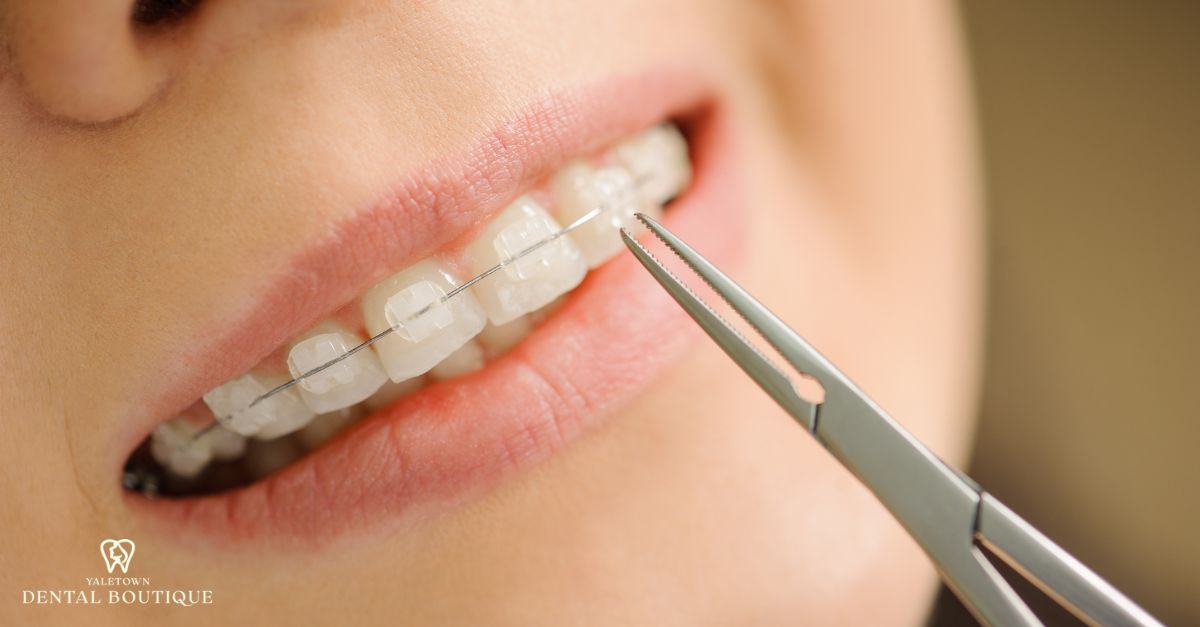
Clear braces, also called ceramic braces, use tooth-coloured brackets made from durable aluminum oxide ceramic.
They function much like metal braces, applying consistent, gentle pressure through a connected archwire to guide your teeth into alignment. What makes them appealing is how discreet they look; their brackets can be either translucent or enamel-shaded, blending seamlessly with your natural smile.
Self-Ligating Ceramic Brackets
Self-ligating brackets are a variation of traditional braces that use a small built-in clip to hold the wire in place rather than elastic ties. The idea is simple: fewer friction points mean smoother tooth movement and shorter chair time during adjustments. In clear (ceramic) versions, this design can make the system easier to maintain, since there are no ligatures that collect pigment or plaque.
Self-ligating braces may reduce friction and shorten appointment times slightly, but the day-to-day experience (fixed brackets, cleaning needs, and in-person visits) remains largely the same.
Polycrystalline vs. Monocrystalline Ceramics
Not all ceramic braces are created equal. The difference lies in how the ceramic is structured, and that structure affects how the brackets look and behave.
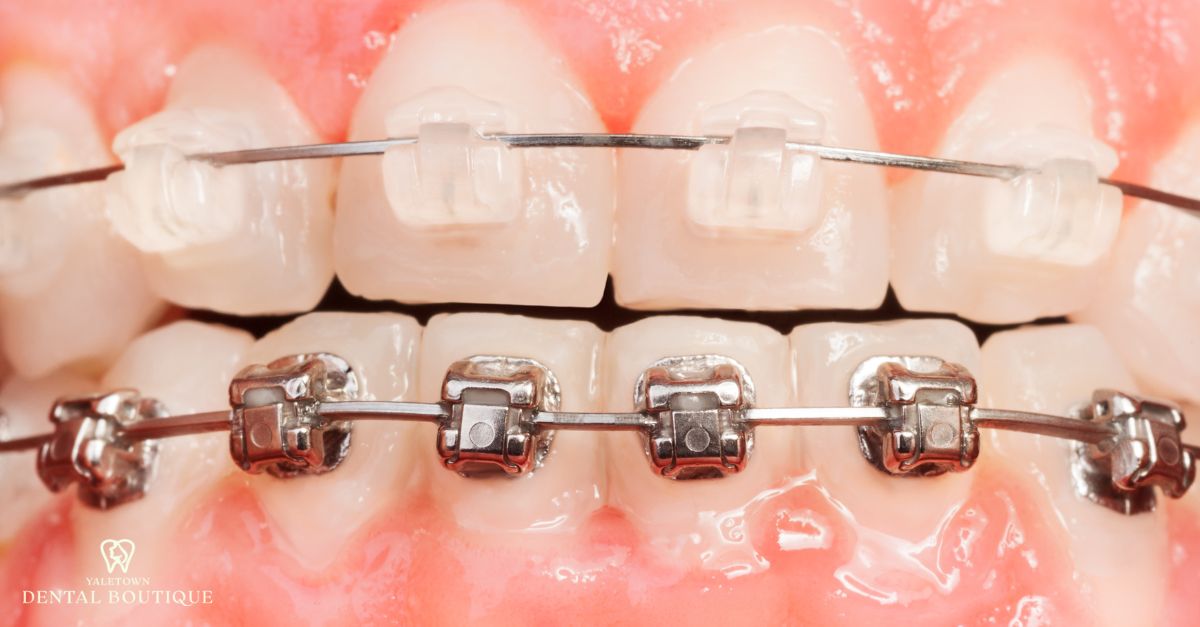
Polycrystalline ceramic brackets have a softer, more opaque appearance. They tend to blend well with natural enamel shades and are a bit more cost-effective. However, under certain lighting, they may appear slightly less translucent.
Monocrystalline ceramic brackets, on the other hand, are made from a single-crystal structure. This gives them a glass-like transparency and a smoother surface, making them more aesthetic and comfortable against the cheeks and lips. They’re also more resistant to staining, but can be more fragile and expensive.
From a mechanical standpoint, both materials perform similarly, but neither can match the flexibility and fracture resistance of metal. That’s one reason why ceramic systems require careful adjustments from an experienced clinician to prevent breakage.
The Appeal of Clear Braces
The main appeal of clear braces is visual confidence. You can correct your smile without the metallic appearance of traditional braces, an important consideration for many adults and teens who want treatment to stay as discreet as possible.
Ceramic brackets are designed to blend with your enamel, making them less noticeable in photos, meetings, or social settings. For some, this balance of aesthetics and control feels reassuring, as they can commit to treatment without feeling self-conscious about every smile.
Clear braces also provide continuous movement since they’re fixed in place, which removes the variable of patient compliance that comes with removable aligners. They work quietly and constantly, keeping teeth in motion toward their ideal alignment.
Do they really stain?
One of the most common concerns about clear braces is whether they stain, and the truth is a little more nuanced than most people expect.
The ceramic brackets themselves rarely stain. They’re made from a dense, non-porous material that resists discoloration even after months of wear.
What usually changes colour are the elastic ligatures, the tiny, clear or white bands that hold the orthodontic wire in place. These ties can absorb pigments from foods and drinks such as coffee, tea, curry, and red wine, giving the appearance that the entire system has darkened.
While ligatures can be replaced during your routine adjustments, staining can occur between visits, especially if you consume dark or acidic foods often. Maintaining excellent hygiene and moderating your diet can help, but some level of discolouration over time is almost inevitable.
That’s where Invisalign® stands apart. Since aligners are removable and replaced every 7–10 days, there’s no opportunity for staining or build-up. You can enjoy your coffee or your glass of wine, brush or rinse, and then simply pop your aligners back in, with no lingering residue, no discoloured ties. In short, yes, clear braces can appear stained over time, but it’s more of a maintenance issue than a material flaw.
Clear vs. Metal Braces and How Invisalign® Fits In
Clear and metal braces rely on the same mechanics — brackets, wires, and gradual pressure — but what separates them today is relevance.
| Table: Clear vs. Metal Braces vs. Invisalign®: A Modern Comparison | |||
| Feature | Metal Braces | Clear Braces | Invisalign® |
| Visibility | High | Moderate | Nearly Invisible |
| Comfort | Moderate | Moderate | High |
| Maintenance | Difficult | Difficult | Easy |
| Durability | Strongest | Brittle | Flexible and Reliable |
| Food Restrictions | Yes | Yes | None |
| Adjustments | Frequent | Frequent | Digital and Minimal |
Metal braces remain reliable for complex orthodontic corrections, while clear braces appeal mainly to those who value a subtler look. Yet both systems share the same drawbacks: they’re fixed, require regular in-office adjustments, limit certain foods, and demand meticulous cleaning around brackets.
That’s why the conversation in modern dentistry has shifted from which type of braces to choose to whether braces are still necessary at all.
Invisalign® delivers the same precision without hardware. With removable, nearly invisible aligners and advanced digital planning, it offers the control of braces and the freedom of a minimalist design, a solution that fits today’s expectations for comfort, aesthetics, and lifestyle.
Durability, Comfort, and Precision: What Really Matters in Orthodontics
When choosing between orthodontic systems, three qualities matter most: how durable they are, how comfortable they feel, and how precisely they move your teeth. Each system handles these aspects differently.
Durability
Metal braces are the strongest of the three. They can withstand heavy forces and are rarely damaged. Clear braces, however, use ceramic brackets that are more brittle. They can crack or chip under pressure, especially when biting hard foods.
Invisalign® aligners take a different approach: instead of fixed hardware, they use flexible SmartTrack material that resists cracking and doesn’t wear down the enamel. You switch aligners every 7–10 days, so they always stay fresh and intact.
Comfort
Traditional and clear braces rely on brackets and wires, which can rub against your cheeks and lips, causing mild irritation until your mouth adapts. Invisalign® aligners are smooth and custom-fitted to your teeth. They don’t cause friction, and since you remove them while eating or brushing, there’s no discomfort from tightening wires or poking edges.
Control
Braces, both metal and ceramic, offer excellent control for complex movement because they’re fixed in place. However, Invisalign® has caught up. With digital 3D planning and real-time progress tracking through Invisalign® Virtual Care, your treatment stays predictable and precisely guided, without in-person adjustments every few weeks.
Caring for Clear Braces
Clear braces demand a higher level of attention when it comes to hygiene. Because ceramic brackets and wires create more surface area for plaque and pigment to collect, daily maintenance plays a major role in keeping your teeth and gums healthy throughout treatment.
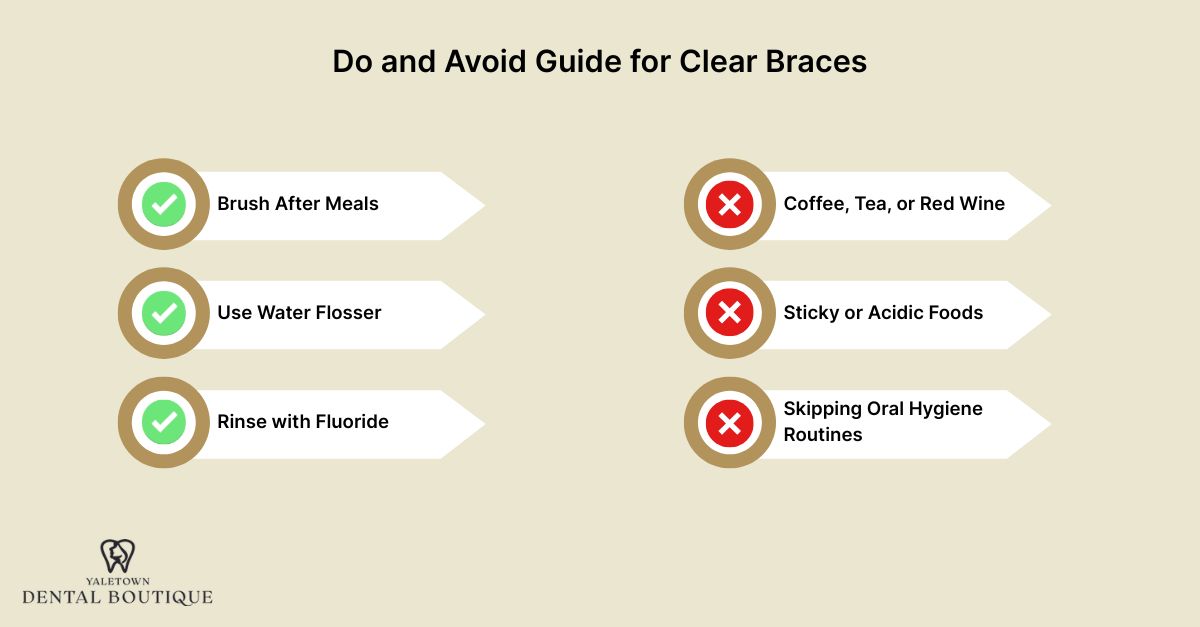
| Infographic: Do and Avoid Guide for Clear Braces | |
| Do | Avoid |
| Brush After Meals | Coffee, Tea, or Red Wine |
| Use Water Flosser | Sticky or Acidic Foods |
| Rinse with Fluoride | Skipping Oral Hygiene Routines |
| Icons: Do: Checkmark Icons Avoid: Cross Icons | |
If you wear clear braces, you need to:
- Brush thoroughly after every meal to prevent food from clinging to the brackets.
- Use an interdental brush or water flosser to reach under the wires and between teeth.
- Rinse with a fluoride mouthwash to protect enamel from early demineralization.
- Avoid dark or acidic foods and drinks such as coffee, tea, soy sauce, and wine to reduce staining around elastic ties.
Who should consider clear braces?
Clear braces were once a popular choice for adults and teens who wanted straighter teeth without the full visibility of metal brackets. They’re most often suited for people who:
- Need moderate to complex tooth movement
- Want a fixed system that doesn’t rely on daily wear discipline
- Are comfortable with more frequent in-office visits and cleaning routines

From Brackets to Digital Precision: Yaletown Dental Boutique’s Approach
At Yaletown Dental Boutique, our goal is to help you understand every option available, even the ones we’ve chosen not to offer. Clear braces remain an important part of orthodontic history, bridging the gap between traditional metal systems and today’s digital solutions.
While we don’t provide ceramic braces, we see value in educating patients about how they work, their advantages, and their limitations. Knowing what’s possible and what’s evolved allows you to make an informed choice about your treatment.
Our clinic has fully transitioned to Invisalign®, a system that reflects how orthodontics has changed: more precise, more adaptable, and more comfortable. Using advanced imaging, AI-powered analysis, and remote monitoring tools, we’re able to design custom aligner treatments that achieve the same biomechanical precision as clear braces once offered without brackets, staining, or lifestyle restrictions.
If you’re exploring orthodontic treatment in Vancouver, our team is here to guide you through your options, explain the science behind them, and recommend what will deliver the healthiest, most natural-looking result for your smile.
Conclusion
Clear braces once represented the height of discreet orthodontic design, but dentistry has evolved. What was once considered a cosmetic innovation has now been surpassed by systems that combine science, comfort, and precision in one seamless experience.
At Yaletown Dental Boutique, we believe that orthodontic care should adapt to how you live, not the other way around. Invisalign® lets you straighten your teeth without changing your eating habits, interrupting your hygiene routine, or drawing attention to your treatment. Every step is planned digitally and monitored carefully, giving you confidence not just in the result, but in the process itself.
If you’re exploring Invisalign® treatment in Vancouver, Yaletown Dental Boutique offers personalized, modern orthodontic care tailored to your smile and lifestyle.
Book your Invisalign® consultation today and take the first step toward a more confident, naturally aligned smile.
Do clear braces stain easily?
The brackets resist staining, but elastic ties can discolour from coffee or wine. Invisalign® aligners are replaced frequently, preventing any lasting discoloration.
Are clear braces as effective as metal braces?
They move teeth effectively but are more fragile. Metal braces handle stronger forces, while Invisalign® achieves similar precision through digital planning and SmartTrack technology.
Do ceramic braces break easily?
Ceramic brackets can crack under pressure or impact. Invisalign® aligners flex naturally, eliminating the risk of breakage or emergency repair appointments.
Which is better: clear braces or Invisalign®?
Both align teeth predictably, but Invisalign® offers superior comfort, flexibility, and aesthetics, making it the preferred choice for most modern orthodontic patients.