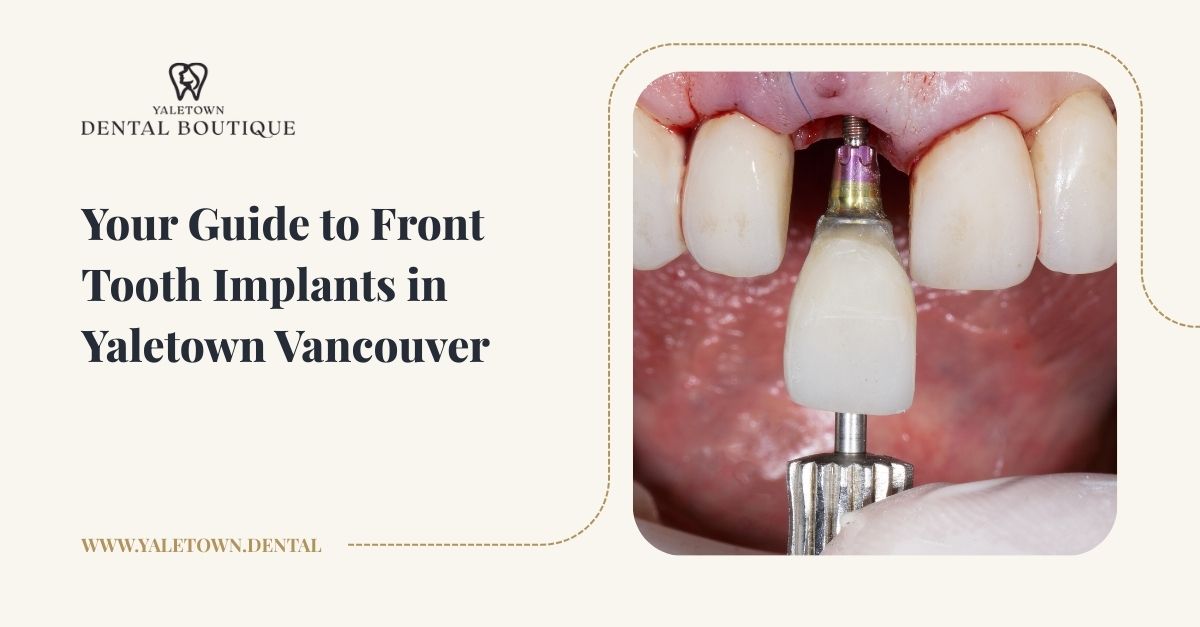
At a Glance:
A front tooth implant is a long-term solution that replaces a missing tooth with a secure, natural-looking result. It involves placing a titanium post into the jawbone, followed by a custom crown that matches your smile. At Yaletown Dental Boutique, we use advanced digital planning and cosmetic detail to restore your tooth and your confidence.
A missing front tooth affects more than just your smile. It can change the way you speak, eat, and carry yourself. Even a single gap can make a big impact. At Yaletown Dental Boutique in downtown Vancouver, front tooth implants are planned and placed with a focus on what matters most: precision in surgery, natural aesthetics, and long-lasting strength. This combination helps ensure your restored tooth is designed to blend naturally with your smile and provide stable function.
Front tooth implants offer a durable, natural-looking solution that matches the colour, shape, and symmetry of your existing teeth. At Yaletown Dental Boutique, we use 3D imaging, guided implant planning, Digital Smile Design (DSD), and AI-assisted diagnostics to create a restoration that feels as close as possible to your original tooth.
This guide walks you through everything you need to know about the process, benefits, recovery, and results, so you can move forward feeling informed and supported.
What is a front tooth implant and how does it work?
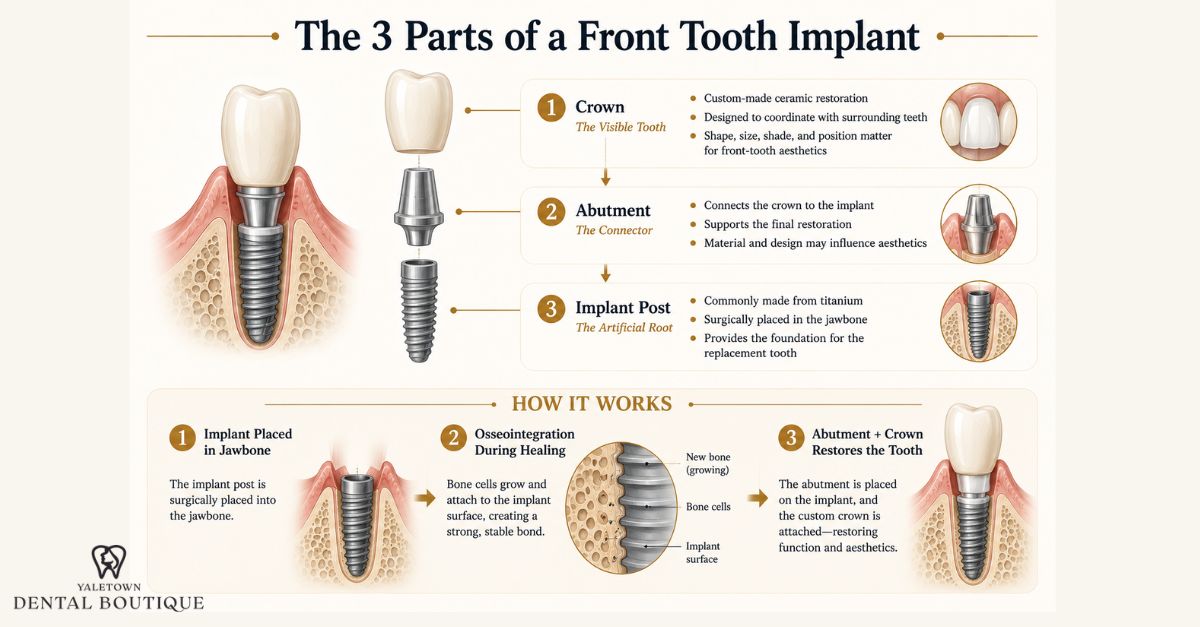
A front tooth implant is a long-lasting, natural-looking replacement for a single missing tooth in the most visible part of your smile. It restores both function and appearance by mimicking the structure of a real tooth root, abutment, and crown. A front tooth implant requires both precise engineering and careful aesthetic planning.
If you’re wondering whether dental implants are safe, our detailed guide explains the safety, success rates, and recovery process for modern implant treatments.
The implant has three parts:
- Implant Post: A small titanium screw placed into the jawbone to act as an artificial root
- Abutment: A connector piece that attaches to the implant and supports the crown
- Crown: A custom-made ceramic tooth that matches your other teeth in shape, size, and colour
Once the implant post is placed, it fuses with the bone through a process called osseointegration. This creates a secure foundation for the crown, which is placed after healing.
For a front tooth, the materials used above the implant can also influence the final appearance. Standard implant systems commonly use titanium components because of their strength and biocompatibility. In selected aesthetic cases, zirconia or other tooth-coloured restorative components may be considered when soft-tissue colour and the appearance of the restoration are important concerns. The appropriate material depends on gum thickness, implant position, bite forces, restorative design, and the individual clinical situation.
Front teeth are especially visible, so aesthetics matter. The shape, alignment, gum line, and shade must all match your surrounding teeth precisely. That’s why detailed planning and cosmetic expertise are essential for a natural result.
Why Front Teeth Are Different (and More Demanding)
Replacing a front tooth isn’t just about filling a gap. It’s about restoring the focal point of your smile. Because front teeth are highly visible, they require extra precision in both planning and execution.
Why Aesthetics Matter More
Front teeth play a key role in your overall appearance, small mismatches can stand out. Here’s why they’re more challenging to replace:
Symmetry: The front teeth help balance your entire smile. A slight difference in size or angle can affect how even your smile looks.
Gum Line Visibility: Because these teeth sit near the lips, uneven gum levels or spacing are easier to notice.
Smile Arc: The curve of your smile must remain consistent. A misaligned implant can interrupt that flow.
Translucency and Texture: Natural front teeth reflect light in subtle ways. A crown that doesn’t match this texture may look artificial.
Gum thickness is another important consideration when planning a front tooth implant. Patients with a thin gum biotype may be more susceptible to visible colour changes, recession, or implant-component show-through, while thicker gum tissue can provide greater masking and contour support. During planning, the clinical team evaluates the gum tissue, underlying bone, implant position, and proposed crown together so the restoration can be designed around the individual anatomy.
For these reasons, front tooth implants demand both surgical precision and cosmetic detail.
Front vs Back Implants
Front teeth require different planning than back teeth because they sit in the most visible part of your smile. This quick comparison shows how the two areas differ in aesthetic and functional demands.
| Key Differences Between Front and Back Implants | ||
| Feature | Front Tooth Implant | Back Tooth Implant |
| Visibility | Highly Visible; Aesthetics Critical | Mostly Hidden; Less Aesthetic Focus |
| Gumline Sensitivity | Gum Contour Must Match Precisely | Small Variations, Less Noticeable |
| Translucency | Shade, Translucency, and Surface Characterization Are Especially Visible | Aesthetic Demands May Be Less Prominent Depending on Visibility |
| Smile Arc | Must Integrate With the Lip and Anterior Smile Curve | Less Direct Influence on the Smile Arc |
| Bite Forces | Must Accommodate Anterior Bite and Guidance Patterns | Often Exposed to Substantial Chewing Forces |
| Crown Proportion | Requires Refined Width and Length | Minor Differences, Harder to Notice |
The Anatomy of a Front Tooth: Dealing With Thin Bone Structures
The bone surrounding the upper front teeth can be particularly thin on the facial, or lip-facing, side. After a tooth is removed, this bone can remodel and lose volume as the extraction site heals.
In the smile zone, those changes matter because the underlying bone helps support the position and contour of the gum around the future implant crown.
This is why careful assessment before implant placement is important. CBCT 3D imaging provides a three-dimensional view of the available bone and surrounding anatomy, allowing the dentist to evaluate bone dimensions and plan the position and angle of the implant. Digital planning and surgical guides can then help transfer that planned position to the clinical procedure.
When the facial bone is too thin or has already lost volume, bone grafting or socket-preservation procedures may be considered to help create appropriate support for implant treatment.
Yaletown Dental Boutique offers CBCT imaging, guided implant planning, implant placement, and bone-grafting procedures as part of its documented implant services.
Aesthetic Challenges of Front Implants
Front tooth implants involve a unique set of challenges that don’t typically apply to molars or less visible teeth. These challenges stem from the intricate way the front teeth interact with the lips, light, and facial expressions.
Here are the primary aesthetic hurdles your dentist must solve:
Soft-tissue support after extraction
The bone and gum tissue in the front of the mouth can shrink quickly after tooth loss. Rebuilding these contours is essential to avoid a collapsed or flattened appearance around the implant.
Maintaining the “papilla” between teeth
The tiny triangular gum tissues between the front teeth (papillae) are difficult to replace if lost. These are vital for a natural, youthful look; even small gaps (“black triangles”) can be noticeable.
Managing the thinness of bone in the front
The bone in the upper front jaw is naturally thin, which limits implant angulation and increases the need for precise placement. Any deviation can affect how the final crown emerges from the gum.
Preventing shine-through of implant components
Front teeth often have thinner gum tissue, meaning dark metallic components may show through if not placed deeply or strategically enough. This requires advanced planning and biomaterial selection.
Smile dynamics under movement
The front teeth are visible not only when smiling but also when talking, laughing, and resting. The implant crown must look natural from every angle and under dynamic lighting, something that requires meticulous planning.
Establishing a natural “emergence profile”
The way the crown appears to grow out of the gum must match the adjacent teeth. This contouring is technically demanding and plays a major role in creating a lifelike final result.
These challenges make front tooth implants one of the most technique-sensitive procedures in dentistry. When planning a dental implant in Yaletown, our team may use digital tools such as 3D imaging, guided implant planning, DSD, and AI-assisted diagnostics to support surgical and restorative planning around the individual anatomy and aesthetic requirements of the implant site.
Why Replacing a Missing Front Tooth Matters
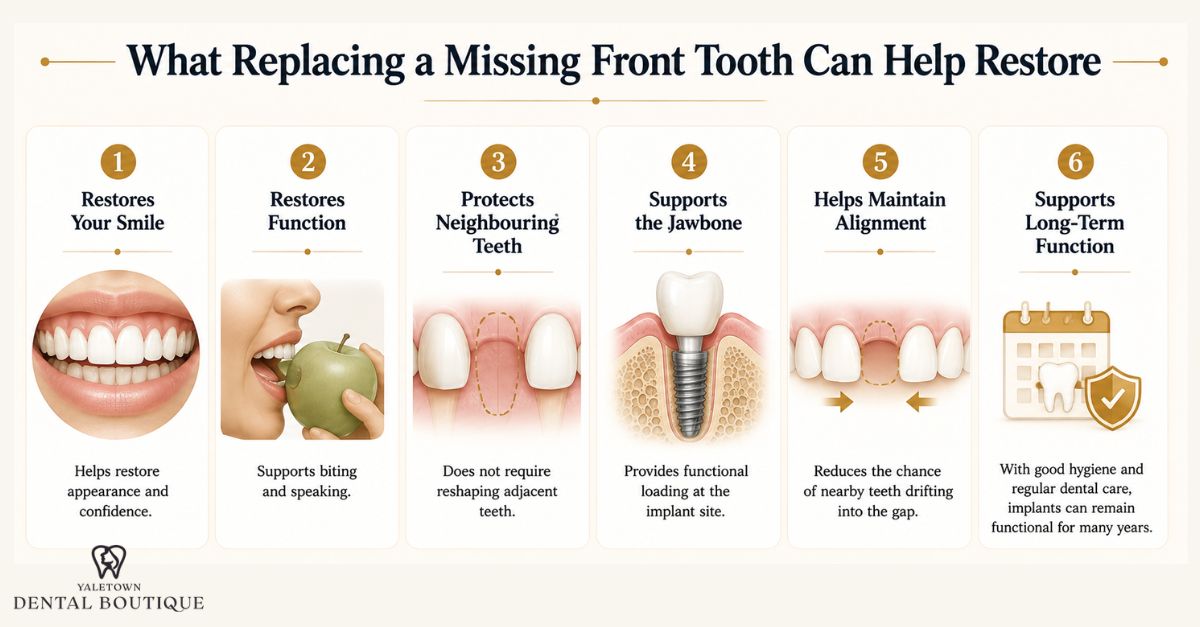
A missing front tooth affects more than just how your smile looks. It can change the way you speak, eat, and feel about yourself. A dental implant helps restore function, prevent future dental issues, and improve your overall comfort and confidence.
1. Restores Smile Confidence
A natural-looking front tooth helps you feel comfortable speaking, laughing, and smiling again. Many patients combine their implant with a full smile makeover in Yaletown for an even more harmonious result.
2. Feels and Functions Like a Real Tooth
Because the implant is anchored in bone, the final crown stays secure during eating and speaking, with no slipping, shifting, or special adhesives.
3. Protects Neighbouring Teeth
Implants stand independently and do not require reshaping healthy adjacent teeth, unlike traditional bridges.
4. Supports the Missing-Tooth Site
Dental implants are anchored in the jawbone and provide functional loading to the surrounding bone. However, normal bone and gum remodelling can still occur, which is why implant position, tissue health, and long-term maintenance remain important.
5. Keeps Alignment in Place
An empty space allows neighbouring teeth to drift or tilt. Replacing the tooth preserves proper bite balance and long-term stability.
6. Long-Lasting and Easy to Maintain
With proper home care, healthy surrounding tissues, and regular dental visits, a front tooth implant can remain functional for many years.
The Front Tooth Implant Process
At Yaletown Dental Boutique, we combine advanced technology with precise planning to support a natural-looking, functional result. Here’s what to expect from start to finish:
| 8 Key Steps of Front Tooth Implant Process1 | ||
| Step | What Happens | What It Means for You |
| 1. Consultation & Assessment | 3D Scans, CBCT, and Exam | Confirms Candidacy |
| 2. Digital Smile Design (DSD) | Preview of Your Future Smile | Supports Early Aesthetic Planning |
| 3. Tooth Extraction (If Needed) | Removal under Local Anesthesia | Prepares the Site |
| 4. Bone Grafting (If Needed) | Adds or Restores Bone | Creates Implant Support |
| 5. Guided Implant Placement | Surgical Guide Supports Planned Position | Helps Transfer the Digital Plan to Surgery |
| 6. Healing & Osseointegration | Bone Fuses over 3–8 Months | Builds Long-Term Stability |
| 7. Healing Abutment Placement | Healing Abutment Is Attached | Helps Shape Gum Tissue for the Final Crown |
| 8. Final Crown Placement | Custom Ceramic Crown Placed | Natural, Secure Tooth Replacement |
1. Consultation and Assessment
Your journey starts with a one-on-one consultation. We use 3D scans and digital imaging to evaluate your teeth, gums, and jawbone, and to confirm you’re a good candidate. We’ll also review your dental history and build a customized treatment plan.
If your tooth was lost due to trauma or sudden pain, our emergency dental service in Yaletown can assess the area and address urgent dental concerns before implant planning begins.
2. Digital Smile Design
We use Digital Smile Design (DSD) to create a visual preview of your future smile. Digital Smile Design (DSD) can support aesthetic planning by helping the dentist evaluate how the proposed restoration relates to your facial features and surrounding teeth before treatment begins.
3. Tooth Extraction (If Needed)
If your damaged front tooth is still in place, it will be gently removed under local anesthesia. For patients who feel nervous about the procedure, we also offer oral sedation to help you stay relaxed and comfortable throughout
4. Bone Grafting (If Needed)
If your jawbone lacks strength or volume, a bone graft may be recommended to support the implant. This adds healing time, but creates a stronger foundation for long-term success.
5. Implant Placement
Once the site is ready, a surgical guide may be used when clinically appropriate to help transfer the digitally planned implant position to the procedure. The implant is then placed according to the treatment plan, and healing begins.
6. Healing Phase (Osseointegration)
Over the next 3 to 8 months, the implant fuses with the jawbone in a process called osseointegration. This creates a stable base for your final crown.
7. Healing Abutment Placement
Once the implant has healed sufficiently, a healing abutment may be placed above the gumline. This temporary component helps the surrounding gum tissue heal and develop an appropriate contour around the implant site, supporting a more natural emergence profile for the final implant crown.
8. Final Crown Placement
Your crown is custom-designed to match the shape, size, and colour of your natural teeth. Once placed, it completes the restoration with a natural-looking, secure tooth replacement.
What Happens to Your Smile While Healing? (The Temporary Solution)
One of the biggest concerns about replacing a front tooth is what your smile will look like while the implant heals. Fortunately, you typically do not have to spend the 3–8 month osseointegration period with a visible gap.
Depending on your treatment plan, a temporary tooth may be prepared to maintain the appearance of your smile during healing. Options can include:
- Temporary flipper: A lightweight, removable partial denture with a replacement tooth that fills the visible space.
- Clear retainer with a temporary tooth: An Essix-style clear appliance containing a tooth-shaped pontic in the missing-tooth area.
- Temporary crown: In suitable cases, a provisional crown may be used while the implant and surrounding tissues heal.
For some patients, an immediate temporary crown may be possible on the day of implant placement. This depends on factors such as implant stability, bone condition, bite forces, and whether bone grafting is required. An immediate temporary crown is therefore not appropriate for every front tooth implant.
A carefully designed provisional tooth can also help support and shape the surrounding gum tissue during healing. This contributes to the emergence profile, which is the contour where the replacement tooth transitions through the gumline and creates the appearance of a natural tooth emerging from the gums.
Your dentist will determine which temporary option is appropriate based on the implant site, your bite, gum and bone anatomy, and the overall treatment plan.
Do you need a bone graft for a front tooth?
Not every front tooth implant requires a bone graft. However, grafting may be recommended when the bone around the missing or damaged tooth is too thin or has lost volume to provide appropriate support for implant treatment.
This is particularly important in the front of the mouth, where the facial bone surrounding the teeth can be naturally thin. After a front tooth is extracted, the empty socket begins to heal and the surrounding bone remodels. Changes in this area can also affect the gum contour that will eventually frame the implant crown.
What is socket preservation?
Socket preservation is a type of bone-grafting procedure performed at the time of tooth extraction. After the tooth is carefully removed, bone-grafting material is placed into the fresh extraction socket to help preserve bone volume as the area heals.
For a front tooth, preserving this underlying structure can be especially important for aesthetics. Preserving ridge dimensions can help maintain bone volume for later implant planning and may support the surrounding tissue contours. Socket preservation can limit post-extraction ridge changes, but it does not eliminate them.
It is not necessary in every case. Your dentist will evaluate the remaining bone, gum tissue, extraction site, and planned implant position to determine whether grafting is appropriate.
At Yaletown Dental Boutique, CBCT 3D imaging can be used to assess the available bone in three dimensions before implant treatment. When additional support is needed, bone grafting can be incorporated into the treatment plan to help create suitable conditions for the implant and its final restoration.
What affects the cost of a front tooth implant in Vancouver?
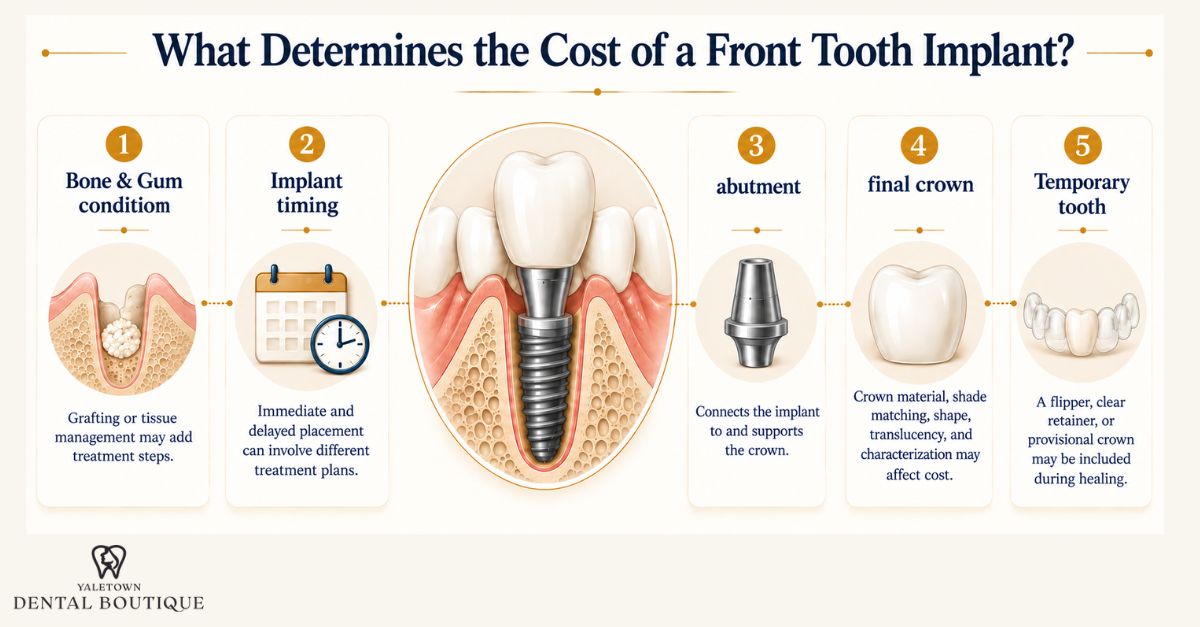
The cost of a front tooth implant in Vancouver varies because treatment involves more than placing the implant itself. Aesthetic considerations such as the final crown material, custom abutment, gum contour, bone volume, and temporary tooth can all affect the overall treatment plan.
Front tooth implant treatment may include the implant surgery, an abutment, and a custom porcelain or ceramic crown. Some patients may also require additional procedures, such as bone grafting, socket preservation, or a temporary tooth during the healing period. These additional steps can affect the overall treatment cost.
Several factors can influence the final cost of a front tooth implant:
- Bone and gum condition: Bone grafting or additional tissue management may be needed when the implant site lacks adequate support.
- Timing of implant placement: Treatment may differ depending on whether the implant can be placed immediately after extraction or requires a separate healing period.
- Final crown: The abutment connects the implant to and supports the crown. The final crown may be made from porcelain, zirconia, or another ceramic material, with custom shade matching, translucency, shape, and surface characterization particularly important when restoring a highly visible front tooth.
- Temporary tooth: A flipper, clear retainer with a temporary tooth, or provisional crown may be incorporated into treatment while the implant heals.
Because every implant site is different, a consultation provides a more accurate estimate based on your bone anatomy, gum tissue, restorative needs, and any additional procedures included in your treatment plan.
For patients who prefer to spread out the cost of treatment, Yaletown Dental Boutique offers 0% interest in-house payment plans tailored to the treatment and individual financial needs. Third-party financing through iFinance (Dentalcard) is also available for eligible treatments.
After Surgery: What to Expect and How to Care for Your Implant
Recovering from a front tooth implant is usually smooth, with most patients experiencing only mild discomfort. Healing progresses in stages, and the dental implant healing time varies depending on bone quality, gum health, and how your body responds after surgery.
| Healing Timeline for Front Tooth Implant | ||
| Stage | What Happens | What You Can Expect |
| Day 1–2: Early Healing | The surgical site begins healing; swelling, minor bleeding, and discomfort may occur. | Rest, follow post-operative instructions, and choose soft foods. Symptoms vary by patient and procedure. |
| Day 3–7: Symptoms Begin to Ease | Swelling and tenderness often start to decrease as early soft-tissue healing continues. | Gentle oral hygiene may resume as directed, while chewing pressure on the area should still be limited. |
| Week 2: Soft-Tissue Healing Continues | Gum tissue continues to heal; sutures may dissolve or be removed depending on the procedure. | Many patients are able to return to normal daily routines, although the implant is still healing internally. |
| Weeks 3–4: Continued Tissue Maturation | The surrounding soft tissues continue to mature and adapt. | Discomfort is often minimal, but pressure on the implant site may still need to be avoided. |
| Months 2–3: Osseointegration Continues | Bone continues to heal around and integrate with the implant. | The implant may feel uneventful during this phase, but internal healing is still taking place. |
| 3–6+ Months: Readiness for Restoration Is Assessed | The dentist evaluates implant stability, bone healing, and surrounding tissues before proceeding with the final restoration. | Timing varies by case. The final crown is placed once the implant and tissues are considered ready. |
Common Post-Surgery Symptom
It’s normal to experience mild symptoms for a few days after surgery, including:
- Swelling or bruising around the gums or jaw
- Minor bleeding at the implant site
- Soreness that can be managed with over-the-counter pain relief
Most people return to daily activities within a few days. However, the internal healing process, known as osseointegration, continues for 3 to 8 months.
Top Recovery Tips
✔ Follow Your Dentist’s Instructions: Stick to all post-op care instructions, including medication, cleaning routines, and follow-up appointments. This helps prevent infection and supports healing.
✔ Eat Soft Foods: Stick to soft, easy-to-chew meals for the first few days, like yogurt, smoothies, scrambled eggs, or mashed vegetables. Avoid chewing near the implant site until cleared by your dentist.
✔ Avoid Smoking and Alcohol: Both can interfere with healing and increase the risk of implant failure. It’s best to avoid them entirely, especially in the early weeks of recovery.
✔ Maintain Gentle Oral Hygiene: Use a soft toothbrush to keep your teeth clean. Avoid brushing directly over the surgical area at first. An antibacterial mouth rinse may also be recommended.
✔ Watch for Signs of Complications: Some discomfort is normal, but contact your dentist if you notice:
- Persistent or increasing pain
- Fever or unusual swelling
- Bleeding that doesn’t stop
- Looseness at the implant site
Prompt attention helps protect your health and your implant.
Oral Hygiene Tips
A gentle cleaning routine reduces irritation and supports healthy tissue recovery. Many patients also maintain long-term care with dental hygiene in Yaletown for consistent monitoring.
- Avoid brushing around the surgical site for a few days.
- Use a soft-bristled toothbrush and non-abrasive toothpaste.
- An antibacterial rinse may be recommended.
- Continue brushing and flossing all other areas normally.
Long-Term Implant Care
Once your implant has healed and your crown is in place, ongoing care is similar in many ways to caring for a natural tooth. Good oral hygiene and regular professional care help support the health of the implant and surrounding tissues over time.
Daily Care Tips:
✔ Brush twice a day using a soft-bristled toothbrush and non-abrasive toothpaste
✔ Floss daily, especially around the implant, to keep gums healthy
✔ Use a water flosser or interdental brush if recommended by your dentist
✔ Avoid biting hard objects, like pens, ice, or fingernails
✔ Visit your dentist regularly for cleanings and check-ups
With good oral hygiene and regular professional care, your front tooth implant can remain functional for many years, although the crown and surrounding tissues may require ongoing maintenance over time.
Local Care in Yaletown
Regular maintenance visits are available at our Yaletown dental clinic in downtown Vancouver to monitor the implant, surrounding tissues, and restoration over time. These visits complement your daily home routine and help preserve the aesthetics and function of your restoration.
Alternatives to Front Tooth Implants
While dental implants can provide a long-term fixed solution, other options are available. Depending on your oral health, anatomy, preferences, and treatment goals, your dentist may recommend an implant, bridge, or partial denture.
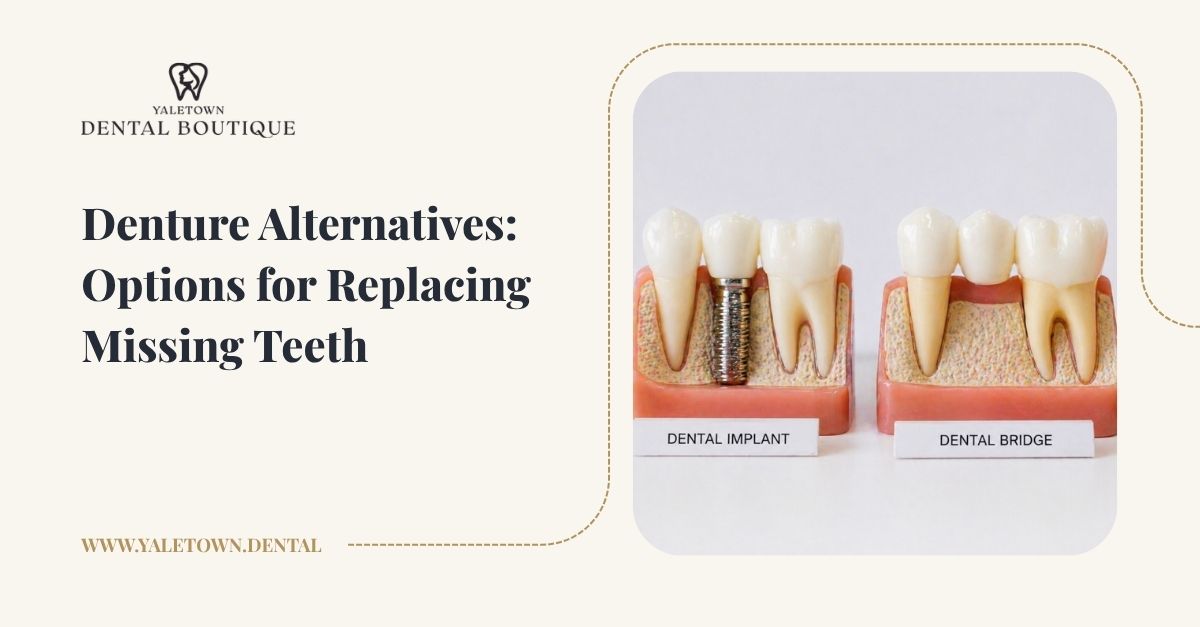
Dental Bridge
A bridge uses the teeth on either side of the gap to support a false tooth (pontic).
Pros:
- Faster treatment
- No surgery required
- Lower upfront cost than implants
Cons:
- Requires reshaping healthy neighbouring teeth
- May not last as long
- Doesn’t protect against bone loss in the jaw
Removable Partial Denture
A removable appliance that replaces one or more missing teeth and can be taken out for cleaning.
Pros:
- Most affordable option
- Non-invasive and quick to make
- No alteration of nearby teeth
Cons:
- Less stable and uncomfortable
- Needs daily removal and cleaning
- Can affect speech and chewing
- Doesn’t prevent jaw bone loss
Bridges and removable partial dentures have different advantages, limitations, maintenance requirements, and treatment considerations compared with dental implants.
Implant vs Bridge vs Denture
Choosing the right replacement depends on bone health, aesthetic priorities, and how you want the tooth to feel in daily life. The table below outlines the key differences.
| Option | Pros | Cons |
| Dental Bridge | Quick; No Surgery | Reshapes Healthy Teeth; No Bone Support |
| Partial Denture | Affordable; Non-Invasive | Less Stable; Affects Speech; Removable |
| Front Tooth Implant | Long-Lasting; Fixed; Does Not Require Reshaping Adjacent Teeth | Higher Cost; Requires Healing |
Each option has advantages and limitations. Dental implants can provide a fixed, long-term replacement without requiring preparation of neighbouring teeth, while bridges and partial dentures may be appropriate depending on the clinical situation and patient preferences.
If you’d like to compare structural differences more deeply, many patients review bridge vs. dental implant considerations when evaluating long-term durability and support.
How do front tooth implants compare with other replacement options?
There is no single best option for every missing front tooth. A dental implant can provide a fixed, long-term replacement without requiring preparation of neighbouring teeth, while bridges and partial dentures may be appropriate in other situations. Patients considering their options can compare dental bridges with implants to better understand differences in treatment, support, and long-term considerations.
The preferred approach depends on bone and gum health, neighbouring teeth, aesthetic priorities, medical history, treatment time, and patient preferences. Your dentist can assess these factors and recommend an appropriate option for your individual situation.
Why Choose Yaletown Dental Boutique
At Yaletown Dental Boutique, front tooth implants are planned with the same attention to detail used in cosmetic dentistry. Every step is designed to protect your oral health while creating a seamless, natural result.
Our approach combines advanced digital planning, guided surgery, and aesthetic design to help plan a restoration that harmonizes with your smile. Patients who prioritize appearance may also explore complementary cosmetic options such as porcelain veneers or Invisalign® in Yaletown, depending on their broader smile goals.
You’ll receive personalized care at every stage, from your first consultation to your final restoration. Our team focuses on precision, comfort, and long-term stability, all within a welcoming boutique environment in downtown Vancouver.
Conclusion
Replacing a missing front tooth can restore more than your smile. It can bring back your comfort, confidence, and daily function. A front tooth implant offers a natural-looking, long-lasting solution that fits seamlessly with your existing teeth.
Long-term success also depends on consistent oral care. Many patients review our dental cleaning guide to understand how maintenance appointments play a role in protecting both the crown and the surrounding gum tissue.
At Yaletown Dental Boutique, we combine advanced 3D imaging and digital smile design with cosmetic dentistry expertise to deliver results that look and feel like your own. Whether you’re just exploring your options or ready to move forward, our team is here to guide you.
Book a personalized consultation for your front tooth implant in Yaletown.
Is a front tooth implant noticeable?
A well-planned front tooth implant is designed to blend closely with the surrounding teeth. Digital Smile Design (DSD) and custom-shaded ceramic restorations help match the crown’s colour, translucency, shape, texture, and overall proportions.
How long does a front tooth implant last?
Dental implants are designed as a long-term tooth replacement. With good oral hygiene, healthy surrounding tissues, and regular dental care, the implant post can remain functional for many years, while the crown may eventually require repair or replacement due to normal wear.
Will I be left without a front tooth during the process?
In many cases, a temporary tooth can be provided during healing so you do not have to live with a visible gap. Options may include a temporary flipper, an Essix-style clear retainer with a replacement tooth, or a provisional crown, depending on your individual treatment plan.
How much does a front tooth implant cost in Vancouver?
The cost of a front tooth implant in Vancouver varies based on the implant procedure, abutment and crown, aesthetic customization, bone or gum condition, grafting needs, and temporary restoration. After an assessment, your dentist can provide an individualized treatment plan and cost estimate.
Does the CDCP cover front tooth implants?
The CDCP does not currently cover dental implants or implant-related procedures. Conventional fixed bridges are also excluded. Certain removable partial dentures may be eligible for coverage, subject to CDCP requirements, frequency limits, and any applicable preauthorization criteria.